Mitochondria and Inactivity: What Sitting Still Does to Your Muscles' Energy Supply
Within days of bed rest, immobilization or a sharp drop in daily steps, measurable changes appear in the mitochondria muscle uses to make energy. What the human studies show about how fast that happens, who loses the most, and what training does afterwards.
Gabriel Radu, DO · Physical Medicine & Rehabilitation · Pain Management
In 1966, five healthy 20-year-old men in Dallas spent three weeks in bed as part of a research study. Thirty years later the same men were tested again, and the investigators concluded that those three weeks of bed rest had had a more profound impact on their physical work capacity than three decades of aging.2
This article looks at one part of what happens inside muscle when people stop moving: the mitochondria, the structures that supply the energy muscle uses to contract. It covers what the human studies show, how quickly the changes appear, who loses the most, and what the training studies show about getting it back. The short version: the earliest changes measured appeared within two days; in the studies that checked, most of the measured loss is in how many mitochondria a muscle has rather than in how well each one works; in the study that compared ages, young and older men lost capacity to the same degree; and when volunteers trained afterwards, their muscle rebuilt what inactivity had removed, at 68 as fully as at 23.
Muscle mitochondria follow demand
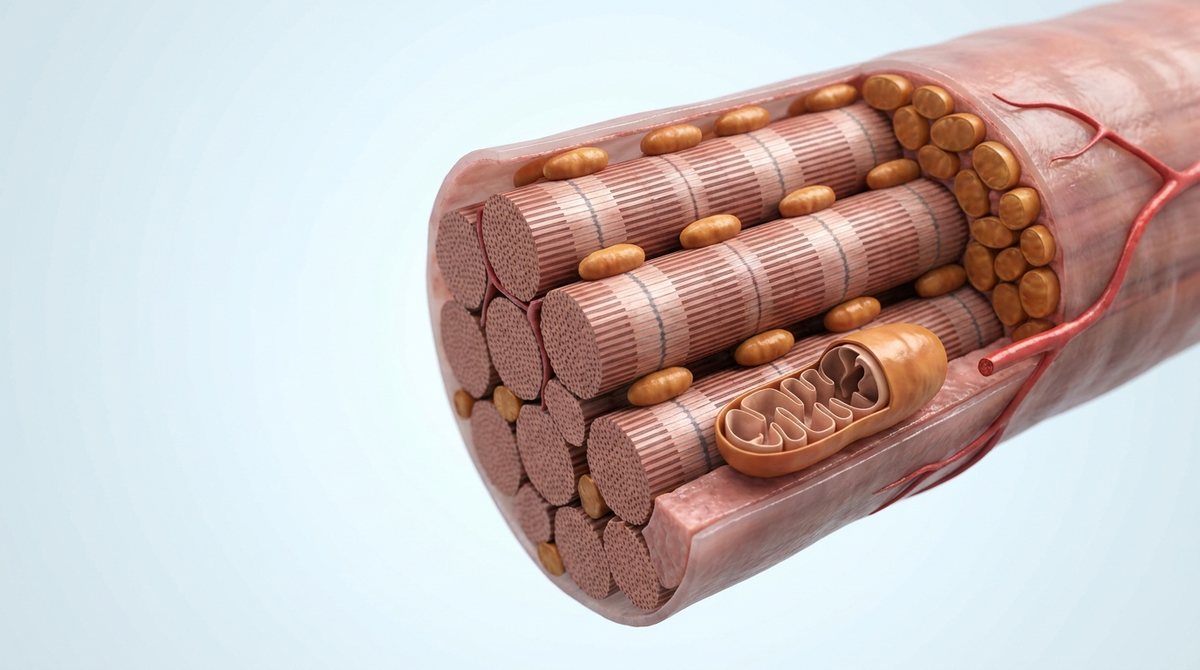
Mitochondria are the main suppliers of ATP, the chemical energy a muscle fiber spends when it contracts. In skeletal muscle they are not a fixed quantity: a 2018 review of the field describes them as adapting their volume, structure and function in response to exercise, disuse, aging and disease.1
According to the same review, a single bout of exercise starts the signaling that builds new mitochondria while worn ones are cleared away, leaving a well-functioning network; with disuse and aging, dysregulation of that network and impaired mitochondrial function contribute to the loss of muscle mass. The review concludes that exercise has the potential to reverse the impaired mitochondrial function seen with aging and chronic disuse.1
How fast the loss begins
The studies in this review used three models of inactivity: strict bed rest, immobilizing one leg, and cutting daily steps to roughly 1,200 to 1,400 a day. All three found changes in muscle mitochondria or metabolism within one to three weeks.
In a McMaster University study, 24 healthy men and women had one leg immobilized for two weeks, with muscle biopsies before, at 48 hours and at 14 days. At 48 hours, genes involved in mitochondrial energy production were already a predominant feature of the changes. By day 14 the immobilized muscle had lost about 5 percent of its cross-sectional area and 10 to 20 percent of its strength, and the activity of two standard mitochondrial enzymes, cytochrome c oxidase and citrate synthase, had fallen.3
Ten healthy young men in Maastricht spent one week in strict bed rest: they lost 1.4 kg of lean tissue, 3.2 percent of quadriceps size, about 6 percent of peak aerobic capacity and of leg strength, and 29 percent of their whole-body insulin sensitivity, and their muscle's oxidative capacity declined.4 In a three-week bed-rest study of nine young men, fat-free mass fell by about 2.9 kg, peak oxygen uptake by 10 to 15 percent, and mitochondrial respiration measured directly in muscle fibers fell alongside insulin sensitivity.5
| Study | Who | What they did | What happened |
|---|---|---|---|
| Abadi 20093 | 24 healthy men and women | One leg immobilized for 14 days | Energy-production genes suppressed by 48 h; mitochondrial enzyme activity down by day 14; ~5% muscle size and 10–20% strength lost |
| Dirks 20164 | 10 young men | 7 days strict bed rest | Muscle oxidative capacity down; insulin sensitivity −29%; lean tissue −1.4 kg; aerobic capacity −6% |
| Kenny 20175 | 9 young men | 21 days bed rest, with and without exercise during it | Mitochondrial respiration down without exercise; fitness −10–15%; resistive vibration exercise during bed rest blunted the fall |
| Gram 2014, 20156,7 | 17 men aged ~23, 15 men aged ~68 | One leg immobilized 14 days, then 6 weeks of cycling | Respiratory capacity down and oxidative stress up after immobilization, equally at both ages; both back to baseline after training |
| Krogh-Madsen 20108 | 10 young men | Steps cut from ~10,500 to ~1,350 a day for 14 days | Insulin sensitivity of muscle −17%; aerobic capacity −7%; leg lean mass down |
| Edwards 20219 | 11 young men | Steps cut from ~13,000 to ~1,200 a day for 7 days | Citrate synthase activity (a marker of mitochondrial amount) down about 6%; other markers unchanged |
| Breen 201310 | 10 adults aged ~72 | Steps cut by ~76% to ~1,400 a day for 14 days | Leg lean mass −3.9%; after-meal insulin sensitivity −43%; muscle-building response to a meal −26%; inflammation markers up |
Inactivity studies in this review. Percentages are group averages from small, carefully controlled studies; individual responses vary.
Fewer power plants, mostly not broken ones
When a study reports that "mitochondrial function fell," it can mean two different things: the muscle has fewer mitochondria, or the mitochondria it has work worse. The two have different implications, so the distinction matters.
Some studies separate the two by adjusting their measurements for citrate synthase, an enzyme that tracks how much mitochondrial material a sample contains. In the three-week bed-rest study, respiration fell when expressed per gram of muscle but not when adjusted for mitochondrial content; in other words, the muscle had less mitochondrial machinery, and on most measures what remained worked as before.5 The two-week immobilization study of young and older men found the same thing: the falls in respiratory capacity disappeared once corrected for mitochondrial content.6
There is one qualitative change worth knowing about. In the same volunteers, two weeks of immobilization raised the mitochondria's output of hydrogen peroxide, a reactive oxygen species, and lowered ATP-generating respiration. Six weeks of cycling restored both to baseline.7 Longer bed rest has also been linked to fat and ceramide building up inside muscle fibers alongside altered mitochondrial structure and function, which the authors attribute to an intracellular nutrient overload.21
Fewer steps, not just bed rest
The step-reduction studies tested a milder change: cutting daily steps sharply for one to two weeks. In one, ten healthy young men who did not exercise cut their steps from about 10,500 to about 1,350 a day for two weeks. The insulin sensitivity of their muscle fell by 17 percent, their aerobic capacity by 7 percent, and the lean mass of their legs declined.8 A shorter study cut eleven young men from about 13,000 to about 1,200 steps a day for one week and found a small, measurable fall in citrate synthase activity, about 6 percent, with no change in most other mitochondrial markers.9
Older adults and hospital stays
When ten adults with an average age of 72 cut their daily steps by about three quarters for two weeks, they lost 3.9 percent of their leg lean mass, their insulin sensitivity after a meal fell by 43 percent, and the muscle-building response to a meal fell by 26 percent, while blood markers of inflammation rose.10 Ten days of bed rest in eleven healthy adults averaging 67 years old cost 13 percent of knee-extension strength, 14 percent of stair-climbing power and 12 percent of maximal aerobic capacity.11
Hospital stays can produce the same pattern. When researchers put movement sensors on 45 older veterans admitted for medical illness, the patients spent on average 83 percent of their measured stay lying in bed, and the median time standing or walking was 43 minutes a day, even though most of them could walk on their own.12 In a cohort of 164 older adults admitted for acute illness, walking during the stay predicted 30-day readmission better than a standard measure of daily-living function did; taking at least 275 steps a day marked the group at lower risk.13
The young and older men in the two-week immobilization study lost mitochondrial capacity to the same degree.6 A 2024 review of disuse in aging concluded that recovery from a period of disuse is harder for older adults than for younger ones, and that resistance training before, during and after the period of inactivity, together with enough dietary protein, is a critical countermeasure.20
How much of "aging" is really inactivity?
Older muscle, on average, has less mitochondrial capacity than younger muscle. In the Baltimore Longitudinal Study of Aging, respiration measured in muscle biopsies from 38 people aged 24 to 91 declined with age, and lower respiration went with lower aerobic fitness, lower muscle strength and a slower 400-meter walk.16 The question is how much of that decline is age itself and how much is the inactivity that usually comes with it.
Studies comparing active and sedentary older adults found that physical activity accounts for part of it. At the Mayo Clinic, the age-related fall in mitochondrial oxidative capacity seen in sedentary people was absent in endurance-trained older adults, although some age differences in mitochondrial DNA and related proteins persisted.14 In Orlando, older adults who stayed highly active had mitochondrial respiration and maximal capacity similar to active people in their thirties, while sedentary people of the same age had lower values, and those values tracked stair-climb time and chair-stand time.15
The Dallas study at the top of this article points the same way at the whole-body level: when its five volunteers were retested 30 years after their three weeks of bed rest, their aerobic capacity had fallen 11 percent over the three decades, and the investigators judged the bed rest to have had the greater impact on work capacity. That study measured whole-body fitness, not mitochondria.2
The way back
The same studies that show the loss show the recovery. After their two weeks of immobilization, the same young and older volunteers did six weeks of supervised cycling. Respiratory capacity and mitochondrial protein content rose back up, the extra hydrogen peroxide output reversed, and the 68-year-olds recovered as fully as the 23-year-olds.6,7
| Study | Who | Training | Mitochondrial result |
|---|---|---|---|
| Gram 2014, 20156,7 | Young and older men after 2 weeks of one-leg immobilization | 6 weeks of supervised cycling | Respiratory capacity and mitochondrial proteins restored; oxidative stress back to baseline; no age difference |
| Short 200317 | 102 men and women aged 21–87 | 16 weeks of aerobic exercise vs. control | Mitochondrial enzyme activity up 45–76%; aerobic capacity up 10%; the response was similar at every age |
| Robinson 201718 | Younger and older adults | 12 weeks of interval training, weight training, or both | All three improved insulin sensitivity and lean mass; only interval and combined training improved mitochondrial respiration; interval training reversed many age-related differences in mitochondrial proteins |
| Little 201019 | 7 young men | 6 interval sessions over 2 weeks (8–12 one-minute hard efforts) | Mitochondrial enzyme activity and protein content increased within two weeks |
Training studies in this review. Ask your clinician before starting interval training, especially after an illness or hospital stay.
The age finding is worth underlining. In the Mayo Clinic training study of 102 people aged 21 to 87, sixteen weeks of aerobic exercise raised mitochondrial enzyme activity by 45 to 76 percent, and the mitochondrial response was the same in older participants as in younger ones.17 In a later Mayo study, twelve weeks of interval training reversed many of the age-related differences in muscle mitochondrial proteins in older adults.18
Two further findings bear on recovery. In the 12-week comparison, all three programs improved insulin sensitivity and lean mass, but only interval training and combined training improved aerobic capacity and mitochondrial respiration; combined training delivered both kinds of gain.18 And in the three-week bed-rest study, the volunteers who did resistive vibration exercise during the bed-rest period showed no fall in mitochondrial respiration, and the fall in insulin sensitivity was mitigated.5
What this means in practice
If you are facing a period of inactivity (surgery, a cast or boot, an illness, a hospital stay), these are the principles the evidence supports. Your own plan should come from the clinician who knows your condition.
- Move what you safely can, every day. The studies show measurable change within days, and exercise during bed rest was partly protective.
- In the hospital, walking counts. In the studies above, older patients spent most of their stay in bed even when they could walk, and more walking during the stay went with lower readmission risk. Ask the team when and how you can walk.
- Expect the loss to be reversible, and plan the rebuild. In every training study here, mitochondrial capacity rose, at every age tested. Six weeks of supervised cycling restored what two weeks of immobilization took away, at 68 as at 23.
- Include both aerobic and resistance work. In the training studies, aerobic and interval training raised mitochondrial capacity, and combined training improved both mitochondrial respiration and lean mass. For older adults, the 2024 review identifies resistance training, with enough dietary protein, as a critical countermeasure to disuse.
What this evidence can't tell you
Most of these studies are small, often ten to thirty volunteers, and several enrolled only men; the bed-rest, immobilization, step-reduction and training experiments studied healthy volunteers rather than people who were ill. Mitochondria were measured in muscle biopsies, mostly from the thigh. The step-reduction studies lasted one to two weeks. And these studies were designed to measure changes, not to prove that lower mitochondrial capacity causes any particular symptom. What they show consistently is the direction and speed of the change with inactivity, and its reversal with training in the studies that tested it.
Sources
- Maintenance of skeletal muscle mitochondria in health, exercise, and aging. Annu Rev Physiol 2018 · PubMed 30216742 · DOI
- A 30-year follow-up of the Dallas Bedrest and Training Study: I. Effect of age on the cardiovascular response to exercise. Circulation 2001 · PubMed 11560849
- Limb immobilization induces a coordinate down-regulation of mitochondrial and other metabolic pathways in men and women. PLoS One 2009 · PubMed 19654872 · DOI
- One week of bed rest leads to substantial muscle atrophy and induces whole-body insulin resistance in the absence of skeletal muscle lipid accumulation. Diabetes 2016 · PubMed 27358494 · DOI
- Bed rest and resistive vibration exercise unveil novel links between skeletal muscle mitochondrial function and insulin resistance. Diabetologia 2017 · PubMed 28500394 · DOI
- Two weeks of one-leg immobilization decreases skeletal muscle respiratory capacity equally in young and elderly men. Exp Gerontol 2014 · PubMed 25193555 · DOI
- Skeletal muscle mitochondrial H2O2 emission increases with immobilization and decreases after aerobic training in young and older men. J Physiol 2015 · PubMed 26096818 · DOI
- A 2-wk reduction of ambulatory activity attenuates peripheral insulin sensitivity. J Appl Physiol 2010 · PubMed 20044474 · DOI
- Short-term step reduction reduces citrate synthase activity without altering skeletal muscle markers of oxidative metabolism or insulin-mediated signaling in young males. J Appl Physiol 2021 · PubMed 34734783 · DOI
- Two weeks of reduced activity decreases leg lean mass and induces “anabolic resistance” of myofibrillar protein synthesis in healthy elderly. J Clin Endocrinol Metab 2013 · PubMed 23589526 · DOI
- Functional impact of 10 days of bed rest in healthy older adults. J Gerontol A Biol Sci Med Sci 2008 · PubMed 18948558 · DOI
- The underrecognized epidemic of low mobility during hospitalization of older adults. J Am Geriatr Soc 2009 · PubMed 19682121 · DOI
- Inpatient walking activity to predict readmission in older adults. Arch Phys Med Rehabil 2016 · PubMed 27264549 · DOI
- Endurance exercise as a countermeasure for aging. Diabetes 2008 · PubMed 18716044 · DOI
- Physical activity unveils the relationship between mitochondrial energetics, muscle quality, and physical function in older adults. J Cachexia Sarcopenia Muscle 2018 · PubMed 29368427 · DOI
- Skeletal muscle ex vivo mitochondrial respiration parallels decline in vivo oxidative capacity, cardiorespiratory fitness, and muscle strength: the Baltimore Longitudinal Study of Aging. Aging Cell 2018 · PubMed 29356348 · DOI
- Impact of aerobic exercise training on age-related changes in insulin sensitivity and muscle oxidative capacity. Diabetes 2003 · PubMed 12882902 · DOI
- Enhanced protein translation underlies improved metabolic and physical adaptations to different exercise training modes in young and old humans. Cell Metab 2017 · PubMed 28273480 · DOI
- A practical model of low-volume high-intensity interval training induces mitochondrial biogenesis in human skeletal muscle: potential mechanisms. J Physiol 2010 · PubMed 20100740 · DOI
- Mitigating disuse-induced skeletal muscle atrophy in ageing: resistance exercise as a critical countermeasure. Exp Physiol 2024 · PubMed 39106083 · DOI
- The impact of bed rest on human skeletal muscle metabolism. Cell Rep Med 2024 · PubMed 38232697 · DOI
This page is educational material only and is not medical advice, a diagnosis, or a treatment recommendation. The illustration at the top is AI-generated and simplified. Evidence summaries are condensed; read the linked studies for details. Before starting or changing an exercise program, especially after surgery, illness or a hospital stay, talk with your physician. In an emergency, call 911.