Basivertebral nerve ablation
Some chronic low back pain comes from damaged, inflamed endplates, the bone surfaces above and below each disc. A nerve inside the vertebra, the basivertebral nerve, carries that pain. Basivertebral nerve ablation (BVNA) uses a small probe to heat and quiet that nerve, and nothing is left behind in your body.
- Same-dayOutpatient, with sedation
- No implantNothing stays in your body
- MRI-confirmedFor pain with Modic changes
- 5+ yearsOf published follow-up data
What is vertebrogenic pain?
Each disc in your spine is sandwiched between two vertebral endplates, the thin layer of bone on the top and bottom of each vertebra. Over time, wear and small injuries can damage these endplates and inflame the bone just beneath them. A nerve inside the vertebra, the basivertebral nerve, carries pain signals from those endplates. Pain that comes from this source is called vertebrogenic low back pain.[2]
What it typically feels like
- A deep ache in the middle of the low back, rather than pain shooting down a leg
- Worse with sitting, bending, lifting, and physical activity
- Present most days for six months or longer
How it is diagnosed
Symptoms alone are not enough. The diagnosis is supported by an MRI showing Modic changes, which are signs of endplate damage and swelling in the neighboring bone. Type 1 Modic changes reflect active inflammation and swelling. Type 2 reflect longer-standing changes with fatty replacement of the bone marrow.[2],[4]
How the procedure works
Basivertebral nerve ablation (BVNA) uses a small probe placed inside the vertebra to heat the basivertebral nerve with radiofrequency energy. This stops the nerve from sending pain signals from the endplates. Nothing is left in your body. Treatment usually targets the vertebrae above and below the painful disc.[2]
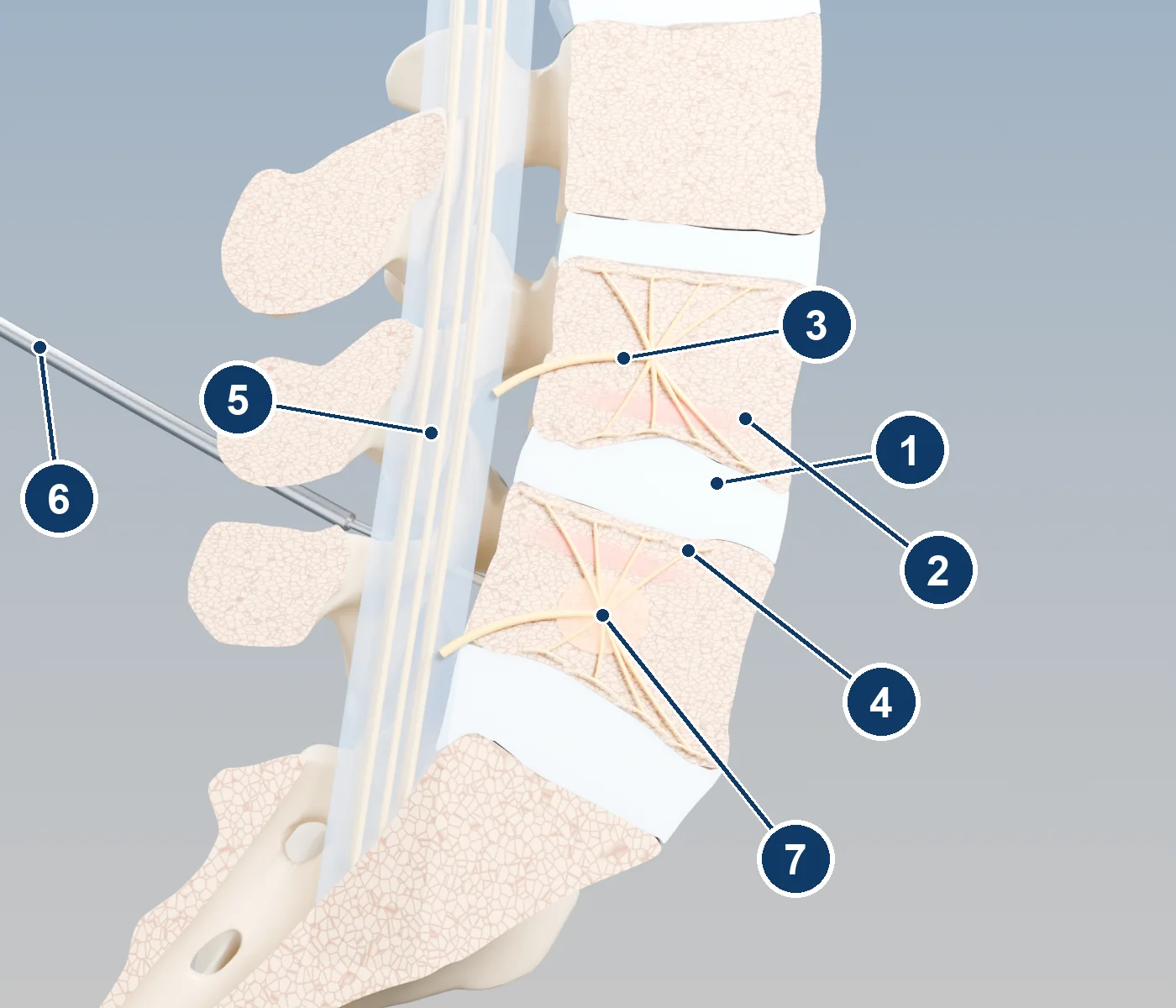
- 1Disc between the two vertebrae
- 2Inflamed endplate zone (Modic change) in the upper vertebra, shaded red
- 3Basivertebral nerve entering from the back of the vertebra and branching toward both endplates
- 4Inflamed endplate zone in the lower vertebra
- 5Spinal canal and nerve roots (not treated by this procedure)
- 6Access cannula, which enters through the pedicle
- 7Heating zone where the nerve branches
Am I a candidate?
BVNA helps one specific kind of back pain, so careful selection matters. The criteria below reflect the clinical trials and Medicare coverage policies. Your own insurer’s rules may differ.[2],[7]
Usually a candidate if
- You have had low back pain for at least 6 months
- It has not improved enough with conservative care, such as physical therapy, activity changes, medicines, or injections
- Your MRI shows Type 1 or Type 2 Modic changes between L3 and S1
- Back pain, not leg pain, is your main problem
- You are an adult whose skeleton has finished growing
Usually not a candidate if
- You are pregnant
- You have an active infection, or an implanted electronic device such as a pacemaker, defibrillator, or stimulator (discuss this with your team)
- Your main pain runs down the leg from a pinched nerve, or you have significant stenosis, slipped vertebrae, or a disc herniation driving your symptoms
- You have significant osteoporosis, a fracture, a tumor, or infection in the spine
- Heart or lung conditions make sedation unsafe
Medicare policies typically allow treatment of 1–2 vertebrae per session and no more than 4 in a lifetime. They do not cover repeating treatment on the same vertebra.[7]
The day of the procedure
Before
We review your MRI and exam. If you take blood thinners, do not stop them on your own. Your prescribing doctor and procedure team will give you a plan. Follow the eating and drinking instructions for sedation, and arrange a driver.
Positioning and sedation
You lie on your stomach. Most patients receive IV sedation or anesthesia, and the skin is numbed.
Access
Using live X-ray, the physician passes a narrow cannula through a small skin opening and the pedicle into the vertebral body.
Treatment
A probe is guided to the point where the basivertebral nerve branches. It heats the nerve for several minutes per vertebra, and the process is repeated for each vertebra being treated.
Home the same day
The small openings are covered with bandages. The whole visit usually takes a few hours, and the procedure itself is often about an hour.
Recovery
- Soreness where the probe entered is common for several days, sometimes up to two weeks. Use ice and the medicines you were advised.
- Walking is encouraged right away. Many people return to light daily activities within a few days.
- Avoid heavy lifting and strenuous exercise until your team clears you.
- Relief often builds over several weeks. In the trials, results were measured at 6 weeks and 3 months, so don’t judge it in the first few days.
- Keep up your exercise program. As pain settles, it is a good time to rebuild core and hip strength with your therapist.
- Track your progress with the Oswestry Disability Index before treatment and again at 6 weeks and 3 months.
What the research shows
BVNA has been studied in two randomized trials, one against a sham procedure and one against standard care, plus long-term follow-up studies.
Versus a sham procedure (SMART)
In 225 patients, 75.6% of treated patients had a meaningful improvement in function at 3 months, compared with 55.3% after a sham procedure. The sham group also improved noticeably, a reminder that expectations and time play a real part.
Versus standard care (INTRACEPT)
Disability scores (ODI) improved about 25 points with BVNA, compared with 4 points with continued standard care, at 3 months. Enrollment stopped early because the difference was clear.
Pain cut in half at 1 year
of treated patients had at least 50% less pain at 12 months, and 29% were pain-free. The share of patients taking opioids did not change significantly at 12 months.
Relief at 2 years
of treated patients had at least 50% less pain at 24 months, and 31% were pain-free. No serious device-related adverse events were reported.
How to read these results
These studies were funded by the company that developed the procedure. Long-term follow-ups did not include a comparison group, and not every patient returned for the later visits. Results apply to carefully selected people with Modic changes. BVNA does not treat back pain from other sources, such as the facet joints, the sacroiliac joint, or a pinched nerve.
Risks and side effects
The clinical trials above reported no serious device-related complications through five years.[4],[6] As with any spine procedure, possible risks include:
- Soreness at the entry sites
- Bleeding or bruising
- Infection
- Irritation or injury of nearby nerves, which can cause leg pain or numbness
- Reactions to sedation or anesthesia
- Not getting enough relief, especially if part of your pain comes from another source
Call your care team right away if you have
- Fever over 101°F (38.3°C), or chills
- Redness, swelling, or drainage at the entry sites
- New weakness or numbness in a leg, or new pain shooting down a leg
- New loss of bladder or bowel control. Go to the emergency room.
- Back pain that is much worse than before and not easing
Questions to bring to your visit
- Does my MRI show Modic changes, and at which levels?
- How confident are you that the endplates, rather than another source, are causing my pain?
- Which vertebrae would be treated?
- What type of sedation will I have?
- When can I return to work, driving, and exercise?
- Does my insurance cover this, and will prior authorization be needed?
References
- Fischgrund JS, et al. Intraosseous basivertebral nerve ablation for the treatment of chronic low back pain: a prospective randomized double-blind sham-controlled multi-center study (SMART). European Spine Journal. 2018;27:1146-1156. doi.org/10.1007/s00586-018-5496-1
- Khalil JG, et al. A prospective, randomized, multicenter study of intraosseous basivertebral nerve ablation for the treatment of chronic low back pain (INTRACEPT). The Spine Journal. 2019;19:1620-1632. doi.org/10.1016/j.spinee.2019.05.598
- Smuck M, et al. Prospective, randomized, multicenter study of intraosseous basivertebral nerve ablation for the treatment of chronic low back pain: 12-month results. Regional Anesthesia & Pain Medicine. 2021;46:683-693. doi.org/10.1136/rapm-2020-102259
- Koreckij T, et al. Prospective, randomized, multicenter study of intraosseous basivertebral nerve ablation for the treatment of chronic low back pain: 24-month treatment arm results. North American Spine Society Journal. 2021;8:100089. doi.org/10.1016/j.xnsj.2021.100089
- Fischgrund JS, et al. Long-term outcomes following intraosseous basivertebral nerve ablation for the treatment of chronic low back pain: 5-year treatment arm results. European Spine Journal. 2020;29:1925-1934. doi.org/10.1007/s00586-020-06448-x
- Khalil JG, et al. Intraosseous basivertebral nerve ablation: a 5-year pooled analysis from three prospective clinical trials. Interventional Pain Medicine. 2024;3:100529. doi.org/10.1016/j.inpm.2024.100529
- Centers for Medicare & Medicaid Services. Local Coverage Determination L39642: Intraosseous Basivertebral Nerve Ablation (example regional Medicare policy). www.cms.gov/medicare-coverage-database/view/lcd.aspx?lcdid=39642
Related guides
About this page. This guide is general education written for patients. It does not replace advice from your own doctor, and results differ from person to person. Numbers quoted come from the published studies listed in the references; many large device studies are funded by the companies that make the devices, which we note where it applies.
Brand names that appear here are trademarks of their owners. This page is independent: it was not produced, paid for, or reviewed by any device manufacturer.
3D illustrations were rendered for this site from the open anatomy models of Z-Anatomy and BodyParts3D (© The Database Center for Life Science, CC BY-SA 2.1 JP; Z-Anatomy, CC BY-SA 4.0). Device hardware is a generic representation, not any specific product. The illustrations are shared under CC BY-SA 4.0.
Last reviewed: September 2026. If you have urgent symptoms, call your care team or 911.