Cervical epidural steroid injection
For pain, tingling, or numbness that runs from the neck into the shoulder or arm because a nerve root is pinched and inflamed. Anti-inflammatory medicine is placed near the inflamed nerve to calm it while it heals.
- About 1 hourVisit from check-in to home
- 2–14 daysFor the steroid to take full effect
- X-ray guidedWith contrast dye and strict safety steps
- With therapyWorks best combined with exercise
Why an epidural injection can help
A disc herniation or bone spur in the neck can press on a nerve root and inflame it. That causes cervical radiculopathy: pain, tingling, numbness, or weakness running from the neck into the shoulder, arm, or hand.
A cervical epidural steroid injection places an anti-inflammatory steroid in the epidural space, the thin fat-filled space just outside the covering of the spinal cord and nerve roots. The aim is to calm the inflamed nerve so pain eases while the problem settles and you work on therapy. It does not remove a disc herniation or bone spur.
Your neck, and where the medicine goes
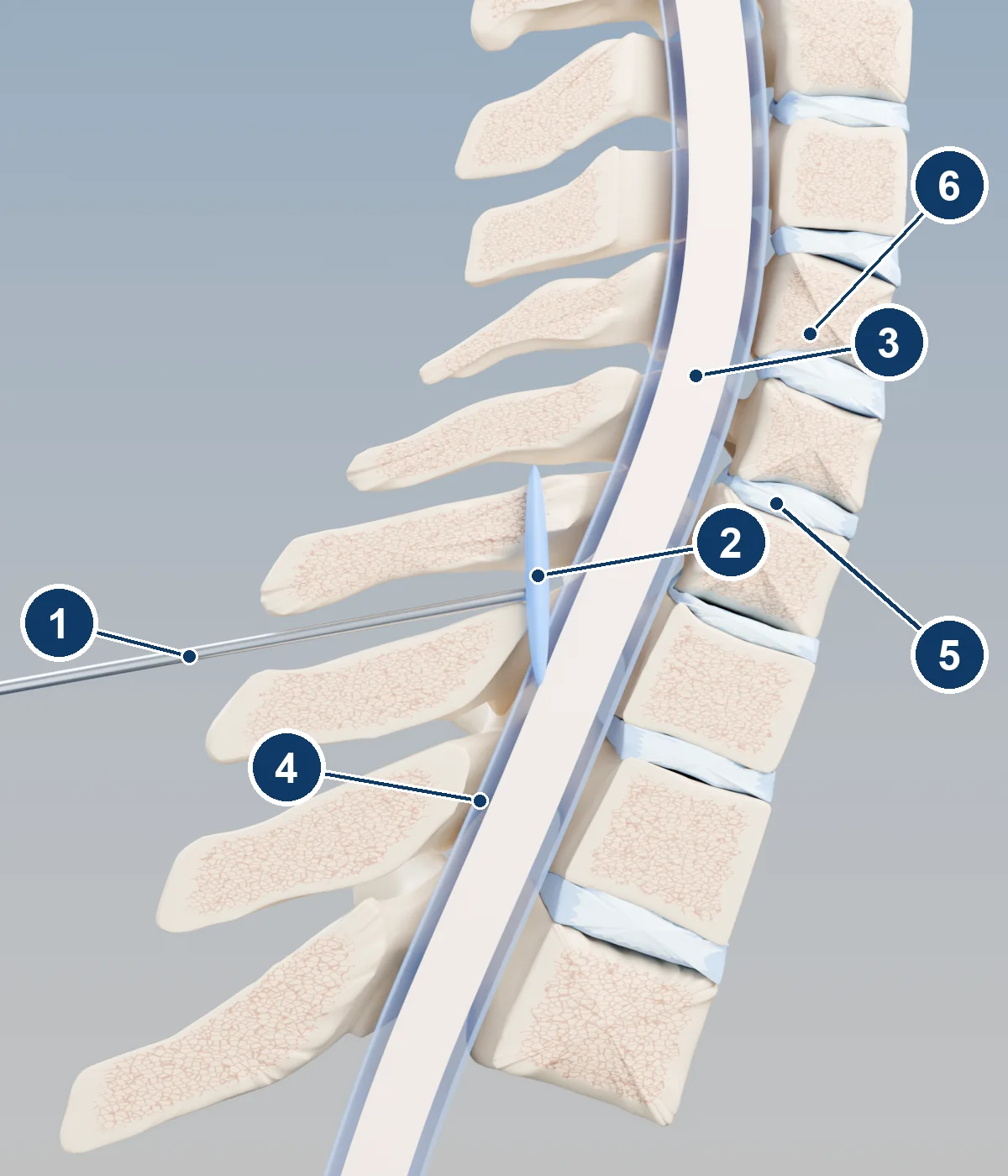
- 1Needle, entering from the back
- 2Medicine in the epidural space
- 3Spinal cord
- 4Dura, the protective covering around the cord and spinal fluid
- 5Disc
- 6Vertebral body
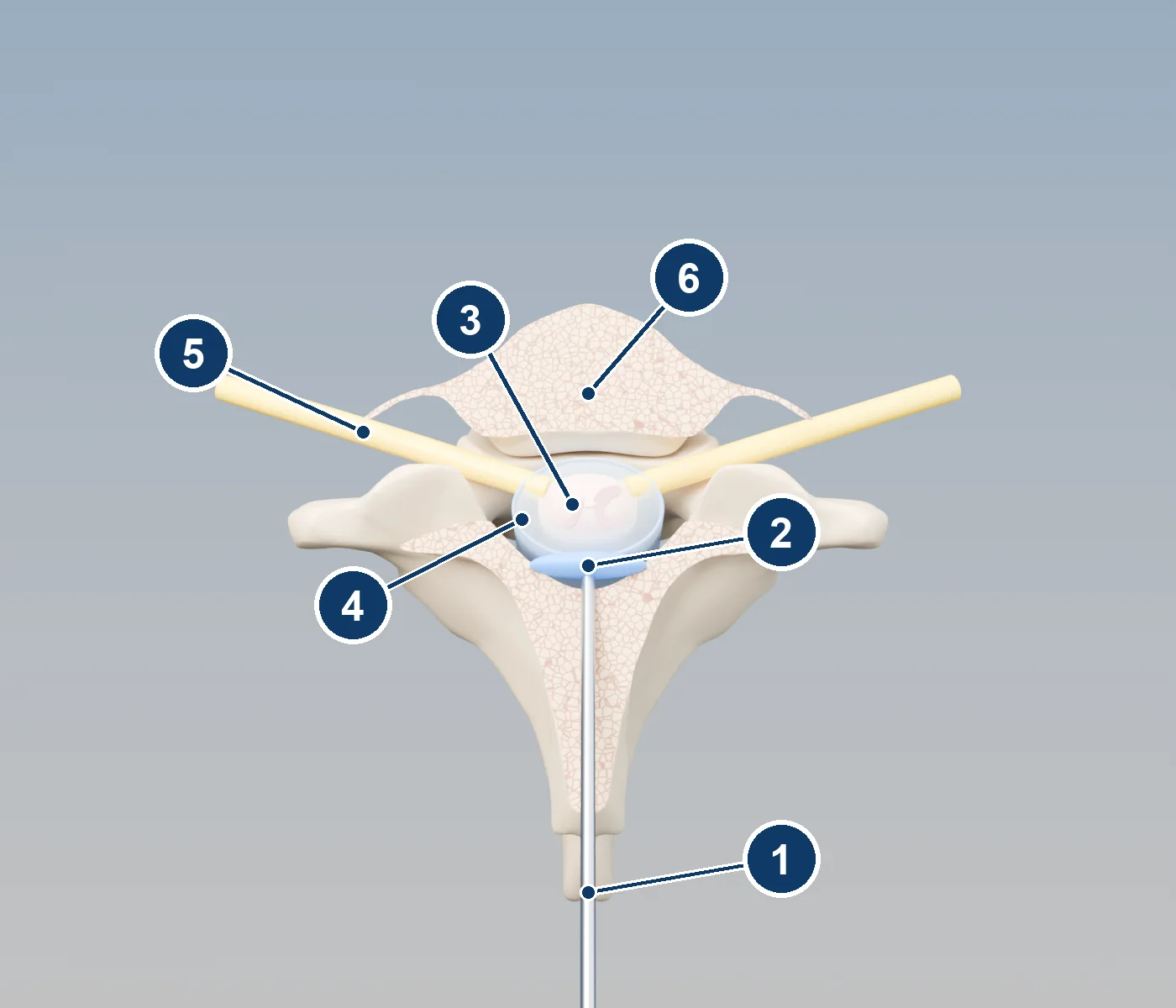
- 1Needle from the back
- 2Medicine in the epidural space
- 3Spinal cord. The darker butterfly shape is its grey matter.
- 4Dura and the spinal fluid around the cord
- 5Nerve root heading to the arm
- 6Vertebral body
Preparing
- At least a week before, give your team a full list of medicines, vitamins, and supplements.
- If you take a blood thinner or anti-platelet medicine, do not stop it on your own. Your prescribing doctor and procedure team will decide together.
- Tell us if you are pregnant or might be, have diabetes, have an infection, or are allergic to contrast dye, iodine, latex, local anesthetic, or steroids.
- Follow any eating and drinking instructions, and arrange an adult to drive you home.
- Bring any outside X-ray, CT, or MRI reports.
Procedure day
Check-in
Consent form, pain rating, and a brief exam. An IV is often placed.
Positioning
You lie on your stomach with your forehead supported, or sometimes sit. Staying very still is important. Tell the team if you need to cough or move.
Numbing and guidance
The skin is cleaned and numbed. Using live X-ray, the physician guides the needle and uses contrast dye to confirm the epidural space.
Medicine
The steroid, sometimes with a numbing medicine or saline, is injected slowly. You may feel pressure or a brief ache into the shoulder or arm.
Home
You rest briefly and then go home with a driver. The whole visit usually takes about an hour.
Afterward
- Neck soreness for a day or two is normal. Use a cold pack for 20 minutes a few times the first day.
- The steroid usually starts working in 2–4 days and can take up to 2 weeks for its full effect.
- Take it easy for the rest of the day, then return to normal activity. Ask when it is OK to drive and return to work.
- If you have diabetes, check your blood sugar more often for several days.
- Neck and shoulder exercises and physical therapy help the improvement last.
Pain log
Bring this to your follow-up visit.
| When | Main pain 0–10 | Arm or leg pain 0–10 | Notes (walking, sleep, medicines) |
|---|---|---|---|
| Before | |||
| 1 hour | |||
| Day 1 | |||
| Day 3 | |||
| Week 1 | |||
| Week 2 | |||
| Week 4 | |||
| Week 6 |
What the research shows
Injection plus therapy works best
In 169 patients with arm pain from a neck nerve, 57% who had injections combined with medicines and physical therapy did well at 3 months, compared with 27% with medicines and therapy alone and 37% with injections alone. At 1 month, arm pain was not significantly different between groups.
Review of placebo-controlled trials
Across trials of nerve-root pain, epidural steroids gave modest short-term relief that did not last in the long term. Most of those trials were in the low back.
The honest summary: a cervical epidural can ease arm pain from a pinched nerve for weeks to months and works best as part of a plan that includes therapy and time. Many neck nerve problems improve on their own over several months.
Risks
Serious problems are rare. Possible side effects and risks include:
- Temporary increase in pain for a day or two
- Headache. A "spinal headache" that is worse sitting up and better lying flat can happen if the covering of the spinal fluid is punctured.
- Facial flushing, trouble sleeping, mood changes, or a temporary rise in blood sugar from the steroid
- Bleeding or infection (rare)
- Allergic reaction
- Stroke or spinal cord injury. These are extremely rare but serious, which is why neck injections follow strict safety steps.
How we keep you safe
In 2014 the FDA required steroid labels to warn about rare but serious neurologic events after epidural injection.[4] A national working group convened with the FDA then issued safety steps that physicians follow, including live X-ray guidance with contrast dye, test doses, and using a non-particulate steroid (such as dexamethasone) for certain approaches.[3]
Call your care team right away if you have
- Fever of 100.4°F (38°C) or higher
- Redness, swelling, or drainage at the injection site
- A severe headache, or nausea
- New or increasing arm weakness or numbness
- Trouble swallowing
- Sudden weakness on one side, trouble speaking, vision loss, or new trouble walking. Call 911.
Questions to bring
- Which level and approach will you use, and why?
- Will you use a non-particulate steroid?
- How many injections might I need?
- When should I start physical therapy?
- What are my options if the arm pain or weakness does not improve?
References
- Cohen SP, et al. Epidural steroid injections, conservative treatment, or combination treatment for cervical radicular pain: a multicenter, randomized, comparative-effectiveness study. Anesthesiology. 2014;121:1045-1055. doi.org/10.1097/ALN.0000000000000409
- Chou R, et al. Epidural corticosteroid injections for radiculopathy and spinal stenosis: a systematic review and meta-analysis. Annals of Internal Medicine. 2015;163:373-381. doi.org/10.7326/M15-0934
- Rathmell JP, et al. Safeguards to prevent neurologic complications after epidural steroid injections: consensus opinions from a multidisciplinary working group and national organizations. Anesthesiology. 2015;122:974-984. doi.org/10.1097/ALN.0000000000000614
- U.S. Food and Drug Administration. Drug Safety Communication: FDA requires label changes to warn of rare but serious neurologic problems after epidural corticosteroid injections for pain. 2014. www.fda.gov/Drugs/DrugSafety/ucm394280.htm
Related guides
About this page. This guide is general education written for patients. It does not replace advice from your own doctor, and results differ from person to person. Numbers quoted come from the published studies listed in the references; many large device studies are funded by the companies that make the devices, which we note where it applies.
Brand names that appear here are trademarks of their owners. This page is independent: it was not produced, paid for, or reviewed by any device manufacturer.
3D illustrations were rendered for this site from the open anatomy models of Z-Anatomy and BodyParts3D (© The Database Center for Life Science, CC BY-SA 2.1 JP; Z-Anatomy, CC BY-SA 4.0). Device hardware is a generic representation, not any specific product. The illustrations are shared under CC BY-SA 4.0.
Last reviewed: September 2026. If you have urgent symptoms, call your care team or 911.