Facet joint injection
Facet joints are small joints at the back of your spine that can cause back or neck pain when they become arthritic or inflamed. A facet injection places medicine directly into the joint, both to check whether it is the source of your pain and to calm it.
- 15–30 minutesFor the injection itself
- Test and treatNumbing medicine plus, often, a steroid
- X-ray guidedFor accurate placement
- Same dayHome within about an hour
What is a facet joint?
Each vertebra in your spine connects to the one above and below it in three places: the disc in front, and two small facet joints at the back, one on each side. Facet joints are about the size of a thumbnail. They are lined with cartilage, wrapped in a joint capsule, and they guide and limit how your spine bends and twists.
Like a knee or a finger joint, a facet joint can wear down with age (arthritis) or be strained by an injury. When that happens it can become a source of back or neck pain.
What facet pain typically feels like
- An ache on one or both sides of the spine, rather than pain shooting far down an arm or leg
- Often worse with leaning backward, twisting, or standing for long periods
- Stiffness first thing in the morning or after sitting
- Low back facet pain can spread into the buttock or upper thigh. Neck facet pain can spread to the shoulder blade or the back of the head.
No single sign on an exam or an MRI proves that a facet joint is the cause. That is why numbing injections are used to test it: if pain drops sharply after a joint or its nerves are numbed, that joint is likely part of the problem.
Why a facet injection is done
A facet injection places medicine, usually a numbing medicine and often a steroid, directly into a facet joint. It can do two jobs:
1. Find the source of pain
If your usual pain drops a lot in the few hours while the numbing medicine is working, that joint is probably involved. This helps your physician decide what to do next.
2. Calm the pain
The steroid can reduce inflammation inside the joint. Some people get relief that lasts weeks to months. Others get only a few hours from the numbing medicine.
The procedure
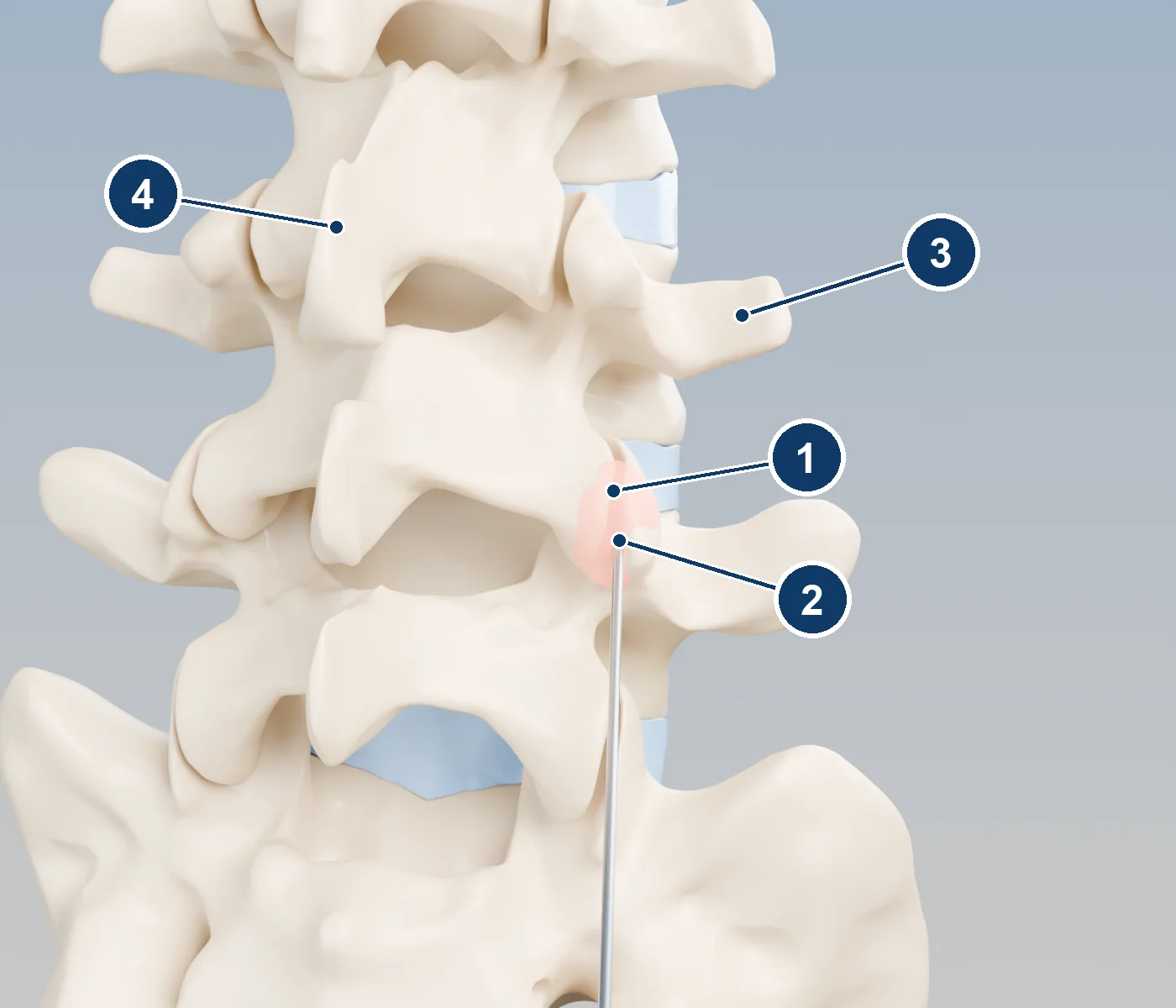
- 1Facet joint, shown inflamed (shaded red)
- 2Needle tip inside the joint
- 3Transverse process, the bony "wing" on the side of each vertebra
- 4Spinous process, the bump you can feel down the middle of your back
Preparing
- At least a week before, give your team a full list of medicines, vitamins, and supplements.
- If you take a blood thinner, do not stop it on your own. Your prescribing doctor and procedure team will decide together.
- Tell us if you are pregnant or might be, have diabetes, have an infection, or are allergic to contrast dye, iodine, latex, or local anesthetic.
- Arrange a driver home.
- Come with your usual pain present. A diagnostic injection is only useful if we can see how much the pain changes.
On the day
Check-in
You sign a consent form and rate your pain on a 0–10 scale.
Positioning
You lie on your stomach for the low back, or on your stomach or side for the neck. Many facet injections are done with local numbing only, so that your pain response can be judged accurately afterward.
Numbing and guidance
The skin is cleaned and numbed. Using X-ray (fluoroscopy) or CT, the physician guides a thin needle into the joint. A small amount of contrast dye confirms the position.
Medicine
A small volume of numbing medicine, often with a steroid, is injected. The whole injection usually takes 15–30 minutes.
Recovery area
You rest briefly, then move in ways that usually cause your pain and rate it again.
Afterward
- The numbing medicine lasts a few hours. Your back or neck may feel more sore than usual for a day or two once it wears off.
- If a steroid was used, it usually starts working in 2–4 days and may take up to 2 weeks for its full effect.
- Ice for 15–20 minutes at a time helps injection-site soreness.
- Take it easy for the rest of the day. Most people return to normal activities the next day.
- If you have diabetes, check your blood sugar more often for a few days. Steroids can raise it.
Pain log for the first 8 hours
Your physician will want to know how much your usual pain changed. Rate it from 0 (none) to 10 (worst), and try the movements that usually hurt.
| Time after injection | Pain 0–10 | What I tried (sitting, standing, bending back, turning) |
|---|---|---|
| Before | ||
| 30 minutes | ||
| 1 hour | ||
| 2 hours | ||
| 4 hours | ||
| 6 hours | ||
| 8 hours | ||
| Next day | ||
| 1 week | ||
| 2 weeks |
What the research shows
Steroid vs saltwater into the facet joint
In a trial of 97 patients with chronic low back pain, 42% improved markedly at 1 month after steroid injection and 33% after saltwater placebo. The difference was not statistically significant.
Guideline view
A 2020 multispecialty guideline found that medial branch blocks predict who will benefit from radiofrequency ablation better than injections into the joint itself.
Coverage limits
Medicare policies in many regions cover no more than four therapeutic facet sessions per spinal region in 12 months, and require relief to be documented each time.
The honest summary: facet injections are good at answering the question "is this joint part of my pain?" Some people also get weeks or months of relief, but the research on steroid injections alone giving long-lasting relief is mixed. Combining any injection with an exercise program gives you the best chance of lasting improvement.
What comes next
If the injection helped a lot but only briefly, your physician may suggest medial branch blocks and then radiofrequency ablation of the small nerves that carry pain from the joint. If it did not help, the facet joint is probably not the main source, and other causes will be looked at.
Risks
Facet injections are considered low risk. Possible problems include:
- A temporary increase in pain
- Bruising or bleeding
- Infection (rare)
- Allergic reaction to the medicine or dye
- Temporary rise in blood sugar, flushing, or trouble sleeping from the steroid
- Nerve irritation or injury (very rare)
Call your care team right away if you have
- Fever of 100.4°F (38°C) or higher
- Redness, swelling, or drainage at the injection site
- New weakness, numbness, or tingling in your arms or legs
- A severe headache
- New loss of bladder or bowel control. Go to the emergency room.
Questions to bring
- Is this injection mainly to find the pain source, to treat it, or both?
- Which joints will be injected, and on which side?
- Will a steroid be used? How will it affect my blood sugar?
- If it works, what is the next step?
References
- Carette S, et al. A controlled trial of corticosteroid injections into facet joints for chronic low back pain. New England Journal of Medicine. 1991;325:1002-1007. doi.org/10.1056/NEJM199110033251405
- Cohen SP, et al. Consensus practice guidelines on interventions for lumbar facet joint pain from a multispecialty, international working group. Regional Anesthesia & Pain Medicine. 2020;45:424-467. doi.org/10.1136/rapm-2019-101243
- Centers for Medicare & Medicaid Services. Local Coverage Determination L38801: Facet Joint Interventions for Pain Management (example regional Medicare policy). www.cms.gov/medicare-coverage-database/view/lcd.aspx?LCDId=38801
- Juch JNS, et al. Effect of radiofrequency denervation on pain intensity among patients with chronic low back pain: the MINT randomized clinical trials. JAMA. 2017;318:68-81. doi.org/10.1001/jama.2017.7918
Related guides
About this page. This guide is general education written for patients. It does not replace advice from your own doctor, and results differ from person to person. Numbers quoted come from the published studies listed in the references; many large device studies are funded by the companies that make the devices, which we note where it applies.
Brand names that appear here are trademarks of their owners. This page is independent: it was not produced, paid for, or reviewed by any device manufacturer.
3D illustrations were rendered for this site from the open anatomy models of Z-Anatomy and BodyParts3D (© The Database Center for Life Science, CC BY-SA 2.1 JP; Z-Anatomy, CC BY-SA 4.0). Device hardware is a generic representation, not any specific product. The illustrations are shared under CC BY-SA 4.0.
Last reviewed: September 2026. If you have urgent symptoms, call your care team or 911.