Virtual reality therapy for chronic low back pain
An FDA-authorized, prescription VR program you use at home for a few minutes a day over 8 weeks. It teaches skills that calm an over-sensitive pain system, without medicine or needles, and works alongside your exercise and other care.
- 8 weeks56 short daily sessions
- At homeSeated or lying down
- No medicineSkills-based, drug-free
- PrescriptionFDA-authorized in 2021
What it is
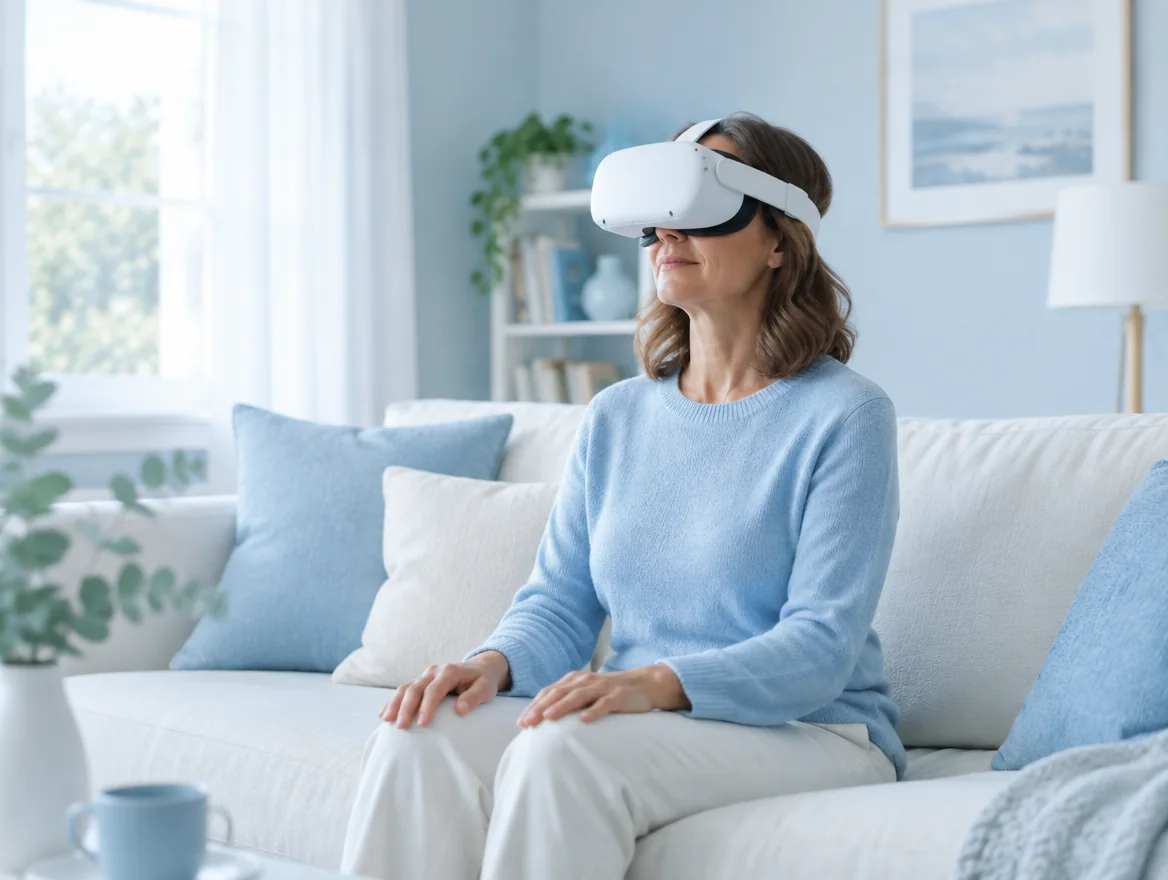
This is a prescription virtual reality (VR) program you use at home for chronic low back pain. You wear a lightweight headset for short daily sessions over 8 weeks. The sessions teach proven pain-coping skills, the same kinds of skills used in pain psychology and cognitive behavioral therapy, in an immersive, guided format.
In November 2021 the FDA authorized the first VR device of this kind, originally called EaseVRx and now marketed as RelieVRx, as a prescription treatment for adults with chronic low back pain.[1] It does not use medicine or needles, and it is meant to be added to your other care, not to replace exercise or therapy.
How it works
Long-lasting pain is not only about the back itself. Over time the nervous system can become more sensitive, and stress, poor sleep, fear of movement, and low mood can all turn the pain signal up. Skills-based pain programs aim to turn that signal back down.
What VR adds
- Full immersion holds attention better than a phone or video
- Guided breathing with visual feedback
- Practice at home, on your own schedule, with no travel
- A structured daily routine for 8 weeks
What it will not do
- It does not fix a disc, joint, or nerve problem
- It does not replace physical therapy or exercise
- It is not a treatment for sudden, new, or severe back pain that has not been evaluated
The 8-week program
The program has 56 sessions, one a day, and most last only a few minutes. It is organized into eight parts that build on each other:
Part 1: Breathing and pain
Slow, guided breathing that settles the body’s stress response.
Part 2: How pain works
Short lessons on why pain can continue after tissues heal, and why that is changeable.
Part 3: Attention and distraction
Immersive scenes that practice shifting attention away from pain.
Part 4: Relaxation
Muscle relaxation and calming imagery.
Part 5: Calming the nervous system
Skills for turning down an over-alert pain system.
Part 6: Body awareness
Mindful attention to the body without fear or judgment.
Part 7: Moving forward
Pacing, goals, and returning to valued activities.
Part 8: Keeping it going
Putting the skills together for life after the program.
Is it right for me?
May be a good fit if
- You have had low back pain for at least 3 months
- Pain interferes with your sleep, mood, activity, or stress level
- You want a non-medicine, non-procedure option to add to your care
- You can commit to a few minutes every day for 8 weeks
Talk with your doctor first if you have
- A history of seizures or epilepsy
- Strong motion sickness, vertigo, or balance problems
- An eye condition or vision that makes a headset hard to use
- New or worsening leg weakness, numbness, or bladder or bowel changes. These need evaluation first.
- A pacemaker or other implanted device (check the headset manufacturer’s guidance)
Getting started
Prescription
Your physician sends the prescription. After your insurance is checked, the headset is shipped to your home.
Setup
The headset comes ready to use. Charge it, fit the strap, and follow the on-screen welcome session.
Daily sessions
One session a day, seated or lying down in a clear, safe space.
Check-ins
Bring your progress to your follow-up visits so we can see how your pain, sleep, and activity are changing.
Tips for getting the most out of it
- Pick a set time each day, such as after breakfast or before bed.
- Sit in a stable chair or lie down. Clear the space around you.
- Take the headset off if you feel dizzy, nauseated, or have eye strain, and rest before trying again.
- Use the breathing and relaxation skills outside the headset too, during flare-ups, before sleep, or during stressful moments.
- Keep up your walking and home exercise program. Skills plus movement work better together.
- Rate your pain and function before you start and at the end. The Oswestry form is a good tool for this.
What the research shows
The program has been tested against sham VR: a headset showing ordinary 2D nature videos, so both groups used a headset every day.
First randomized trial (179 adults)
After 8 weeks, the skills program reduced pain intensity and how much pain interfered with activity, mood, and stress more than sham VR did. Over-the-counter pain reliever use fell; prescription opioid use did not change significantly.
Follow-up of the same trial
Six months after the program ended, it was still better than sham for pain intensity and interference with activity, stress, and sleep. No participant reported side effects such as nausea or motion sickness.
Large trial (1,067 adults)
Average pain fell about 2 points on a 0–10 scale, and interference about 2.3 points. The advantage over sham VR was smaller, about half a point, because the sham group improved too.
Longer-term report
The company reported that pain reductions in the first trial persisted up to 24 months after treatment.
How to read these results
All of these studies were run or funded by the company that makes the device, participants were recruited online and reported their own symptoms, and the extra benefit over a sham headset was modest. The program is a low-risk option that helps many people build useful skills. It is not a substitute for an evaluation of new or worsening back pain.
Safety
Few side effects were reported in the trials. As with any VR headset, some people feel dizziness, nausea, eye strain, or headache, especially in the first sessions. Stop and rest if this happens. Use the headset seated or lying down, away from stairs and furniture edges.
Insurance and cost
In 2023 Medicare created a billing code (E1905) and classified this type of therapeutic VR device as durable medical equipment.[6] Coverage still varies by plan, and some plans require prior authorization. The company or your care team can check your benefits before the headset ships.
Questions to bring
- Is my back pain the kind this program is designed for?
- How does it fit with my physical therapy and other treatments?
- What will my insurance cover?
- Who do I call if the headset isn’t working?
- What happens after the 8 weeks?
References
- U.S. Food and Drug Administration. De Novo classification DEN210014, EaseVRx (now marketed as RelieVRx), virtual reality behavioral therapy device for pain relief, granted November 16, 2021. www.accessdata.fda.gov/scripts/cdrh/cfdocs/cfpmn/denovo.cfm?id=DEN210014
- Garcia LM, et al. An 8-week self-administered at-home behavioral skills-based virtual reality program for chronic low back pain: double-blind, randomized, placebo-controlled trial conducted during COVID-19. Journal of Medical Internet Research. 2021;23:e26292. Conducted by the device maker. doi.org/10.2196/26292
- Garcia L, et al. Durability of the treatment effects of an 8-week self-administered home-based virtual reality program for chronic low back pain: 6-month follow-up study of a randomized clinical trial. Journal of Medical Internet Research. 2022;24:e37480. doi.org/10.2196/37480
- Maddox T, et al. In-home virtual reality program for chronic lower back pain: a randomized sham-controlled effectiveness trial in a clinically severe and diverse sample. Mayo Clinic Proceedings: Digital Health. 2023;1:563-573. Conducted by the device maker. doi.org/10.1016/j.mcpdig.2023.09.003
- Maddox T, et al. Durable chronic low back pain reductions up to 24 months after treatment for an accessible, 8-week, in-home behavioral skills-based virtual reality program: a randomized controlled trial. Pain Medicine. 2023;24:1200-1203. doi.org/10.1093/pm/pnad070
- DLA Piper. CMS issues first HCPCS code and Medicare DME benefit category determination for therapeutic virtual reality device. April 2023. www.dlapiper.com/en-us/insights/publications/2023/04/cms-issues-first-hcpcs-code-and-medicare-dme-benefit-category-determination
Related guides
About this page. This guide is general education written for patients. It does not replace advice from your own doctor, and results differ from person to person. Numbers quoted come from the published studies listed in the references; many large device studies are funded by the companies that make the devices, which we note where it applies.
Brand names that appear here are trademarks of their owners. This page is independent: it was not produced, paid for, or reviewed by any device manufacturer.
3D illustrations were rendered for this site from the open anatomy models of Z-Anatomy and BodyParts3D (© The Database Center for Life Science, CC BY-SA 2.1 JP; Z-Anatomy, CC BY-SA 4.0). Device hardware is a generic representation, not any specific product. The illustrations are shared under CC BY-SA 4.0.
Last reviewed: September 2026. If you have urgent symptoms, call your care team or 911.